Password Security Isn’t Paranoia. It’s Basic Survival.
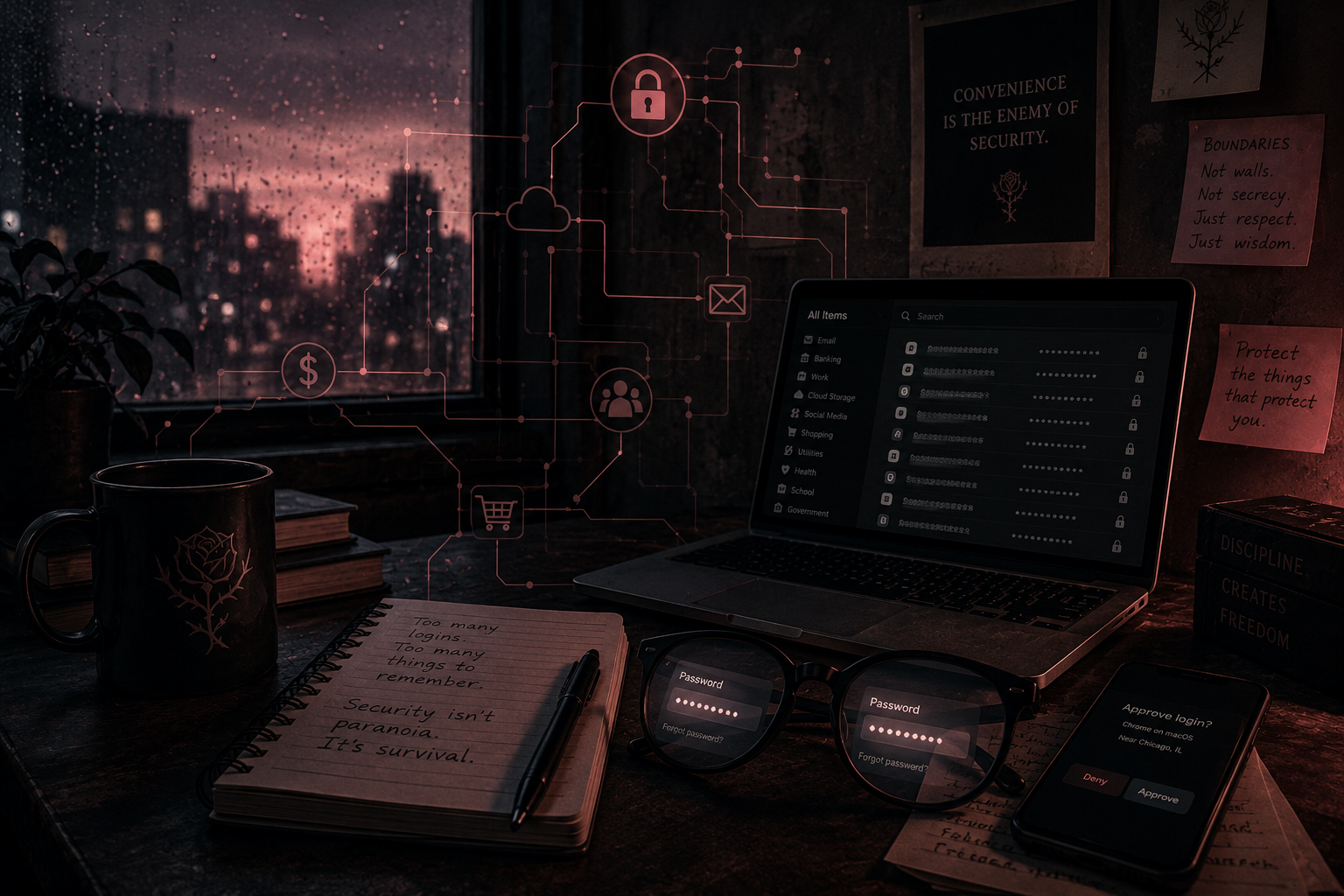
Most people imagine hacking as something cinematic.
A genius in a dark room. Multiple monitors glowing neon green. Someone rapidly typing through layers of encryption while alarms flash across a corporate network. Popular culture trained people to imagine cybersecurity breaches as highly targeted attacks carried out by exceptionally skilled individuals against specific victims.
In reality, most account compromises are far more ordinary than that.
Someone reused a password.
That is often the entire attack.
Not because the victim was unintelligent. Not because they “deserved it.” And not because they failed some impossible cybersecurity purity test. Modern digital life quietly trained people into habits that prioritize convenience, speed, memorization, and accessibility over actual security.
Most people are not cybersecurity professionals. They are exhausted human beings trying to manage banking apps, healthcare portals, school systems, streaming services, cloud storage, government websites, shopping accounts, social media, work platforms, and dozens—sometimes hundreds—of logins spread across an internet that never slows down.
So people reuse passwords. They save credentials in unsafe places. They share account access with partners or family members. They disable security prompts because the interruptions become frustrating. They click links too quickly because every platform demands urgency and immediate attention all the time.
And companies helped create this problem.
For years, large parts of the technology industry treated security as secondary to growth, engagement, convenience, and frictionless user experiences. At the same time, data breaches became so common that many people barely react anymore when another company quietly announces that millions of usernames, passwords, email addresses, phone numbers, or personal records were exposed.
The result is a world where ordinary people are expected to function as their own personal security department without ever being properly prepared for that responsibility.
That is why password security matters now more than ever. Not because paranoia is fashionable. Not because everyone is being individually targeted by elite hackers. But because modern life increasingly depends on digital systems that were never designed with exhausted human behavior fully in mind.
Your passwords are no longer protecting “just” online accounts.
They are protecting your identity, your finances, your healthcare access, your private conversations, your memories, your work, and increasingly, your ability to participate safely in everyday life.
The Myth of “Getting Hacked”
The phrase “I got hacked” makes it sound personal.
Sometimes it is. Targeted attacks are real. Stalkerware is real. Revenge-based account access is real. Workplace compromise is real. Some people are specifically singled out because of who they are, what they know, what they have survived, or what systems they can access.
Those violations matter.
But most everyday account compromises are not that personal.
A lot of them begin with automation. Attackers take usernames, email addresses, and passwords leaked from one breach, then test those credentials against other services at scale: banking sites, email providers, shopping accounts, streaming services, cloud storage, gaming platforms, social media accounts, workplace portals, and anything else that might open with the same key.
That is why password reuse is so dangerous.
The attacker does not need to know you. They do not need to guess your childhood pet’s name, study your social media, or break through a firewall like they are in a movie. They only need one password from one breached service and enough automation to see where else it works.
That kind of attack is boring.
It is also efficient, scalable, and incredibly effective.
It changes how we should think about responsibility. When someone loses an account, the story is rarely as simple as “they were careless.” More often, they were living inside a broken system where companies collected too much data, protected it imperfectly, designed login systems around convenience, and left ordinary users to clean up the damage after something leaked.
That does not mean individual habits do not matter. They absolutely do. But blaming users alone misses the larger point: modern account security is built on layers of trust most people cannot see, verify, or control.
You can do almost everything right and still be affected by a breach somewhere else.
The goal, then, is not to become impossible to compromise. That is not realistic. The goal is to prevent one failure from becoming a full collapse. One breached website should not unlock your email. One leaked shopping password should not open your bank account. One old login from a service you forgot about should not become the doorway into your private life.
That is the real myth of “getting hacked”: the idea that it always begins with someone breaking directly into your life.
Sometimes, they are just trying every leaked key until one of them opens a door.
Why Password Reuse Becomes Catastrophic
Most people do not reuse passwords because they are irresponsible.
They reuse passwords because modern digital life asks human beings to remember an absurd number of credentials across an absurd number of systems. Banking apps, healthcare portals, insurance websites, utility companies, tax services, shopping accounts, school systems, workplace logins, streaming platforms, social media, cloud storage, gaming services, food delivery apps, smart home devices, and government portals all demand separate accounts with separate password requirements, separate login rules, separate recovery methods, and constant authentication.
The average person is not managing five passwords anymore.
They are managing dozens. Sometimes hundreds.
And human memory was never designed for that.
So people adapt the only way exhausted human beings usually do: they create patterns. A favorite password gets reused across multiple sites. A few characters change from service to service. A year gets added at the end. An exclamation point rotates locations. A pet’s name evolves into slight variations that still feel memorable enough to survive daily life.
Humans are good at memorizing patterns.
Attackers understand that extremely well.
Modern cybercrime is built around predictable human behavior far more than technological genius.
When a company suffers a breach, attackers rarely care only about the compromised platform itself. The real value comes from what those credentials might unlock elsewhere. Leaked usernames, email addresses, and passwords are collected into enormous databases that get sold, traded, shared, and automated across criminal ecosystems. Software then tests those credentials against other platforms at scale because attackers know something very simple: people reuse passwords constantly.
This process is called credential stuffing, and despite the unimpressive name, it is responsible for an enormous number of account compromises across the internet.
The attacker does not need to know who you are. They do not need to target you personally. They do not need advanced malware or some cinematic hacking setup.
They just need one valid key and enough automation to try it against enough doors.
That is where the damage escalates.
People often think about accounts individually. A compromised streaming account feels annoying but manageable. A compromised shopping account feels stressful but recoverable. But modern digital systems are deeply interconnected in ways most people never fully see until something goes wrong.
Email changed everything.
Most account recovery systems route through email, which means access to one inbox can quietly become access to almost everything else attached to your digital identity. Financial services, cloud backups, healthcare portals, workplace systems, tax documents, subscription services, social media accounts, authentication resets, personal conversations, years of photographs, private files, and sensitive records may all become reachable from a single compromised email account.
People imagine account security as separate locked rooms.
In reality, most digital accounts are connected like dominoes.
One weak password does not always stay one weak password for very long.
And the situation becomes even more dangerous because breaches are now so common that many people already have credentials circulating online without realizing it. Old forums, abandoned apps, forgotten shopping websites, outdated gaming services, and companies people barely remember signing up for may still contain active credentials tied to current email addresses years later.
The internet rarely forgets old access.
Attackers know that too.
That is why password reuse is no longer just a minor bad habit or a lazy shortcut. It is one of the few security mistakes capable of turning a single compromised account into a chain reaction that spreads across an entire digital life.
And the worst part is that most people do not realize how exposed they are until after the collapse has already started.
Security Fatigue and Human Exhaustion
One of the biggest problems in modern cybersecurity has very little to do with technology itself.
It has to do with exhaustion.
Most security systems quietly assume people are operating at full attention all the time. They assume users carefully inspect every link, read every notification, recognize every phishing attempt, maintain perfect password hygiene, monitor account activity consistently, update devices immediately, understand evolving threats, and make rational security decisions no matter how overwhelmed life becomes.
That is not how human beings actually function.
Modern digital life floods people with constant demands for attention. Notifications never stop. Emails arrive endlessly. Apps demand immediate responses. Platforms train users to move quickly, click quickly, approve quickly, and multitask continuously across dozens of systems at once.
Security exists inside that environment.
That matters because exhausted people stop analyzing interactions carefully. They approve login prompts without thinking. They skim emails too quickly. They miss subtle warning signs. They delay updates because they are busy. They reuse passwords because they cannot mentally handle another credential. They click links while distracted at work, exhausted after parenting, emotionally distressed, chronically ill, sleep deprived, burned out, or simply trying to survive too many responsibilities at once.
Attackers understand this extremely well.
A huge percentage of modern cybercrime relies less on “breaking into systems” and more on manipulating human behavior under pressure. Phishing emails create urgency. Scam calls create fear. Fake login pages imitate familiar platforms. Fraud messages pressure people to act immediately before they have time to slow down and think critically.
The goal is often not technical brilliance.
The goal is interruption of judgment.
And modern internet culture has trained people to override their own caution constantly. Everything online competes for speed and engagement. Platforms reward immediacy. Workplaces expect rapid responses. Notifications are intentionally designed to feel urgent whether they actually are or not.
Over time, people stop treating security warnings as meaningful signals and start treating them as obstacles interrupting whatever they were already trying to do.
That is security fatigue.
It is the gradual psychological exhaustion that develops when people are expected to remain constantly vigilant across systems that never stop demanding attention.
The problem becomes even worse because cybersecurity advice is often delivered with blame instead of realism. When breaches happen, people are mocked for “falling for scams,” reusing passwords, or missing warning signs while very little attention is given to the fact that many digital systems are intentionally designed around maximizing engagement, minimizing friction, and accelerating user behavior rather than encouraging careful decision-making.
In other words, modern technology often trains the exact habits attackers later exploit.
That does not mean personal responsibility disappears. People still need to take reasonable precautions. But meaningful security conversations have to acknowledge reality: human beings are not machines, and systems that depend on endless perfect vigilance will eventually fail.
Especially when the average person is already mentally overloaded long before cybersecurity enters the picture.
The future of security cannot rely entirely on expecting exhausted people to become full-time threat analysts for every app, platform, email, notification, and login request in their lives.
Because exhaustion is no longer the exception.
For many people, it is the default state.
Password Managers: Why Humans Are Bad at Passwords
At this point, most cybersecurity advice usually turns into scolding.
Use stronger passwords. Do not reuse passwords. Make every password unique. Memorize complex credentials. Change them regularly. Never write them down. Never forget them. Never make a mistake.
Technically, much of that advice is correct.
Practically, a lot of it ignores reality.
Human beings are not good at managing large amounts of random information indefinitely, especially under stress, exhaustion, distraction, chronic illness, overwork, parenting responsibilities, financial pressure, or the constant cognitive overload created by modern technology. Most people are already trying to juggle hundreds of invisible tasks every single day before cybersecurity even enters the conversation.
That matters because security systems designed without realistic human behavior in mind usually fail.
People do not create weak password habits because they enjoy risk. They create weak password habits because the modern internet asks them to maintain an impossible balance between convenience, memory, speed, and security across dozens or hundreds of accounts at the same time.
Password managers exist because human beings were never supposed to do this manually.
A good password manager changes the problem entirely. Instead of trying to memorize dozens or hundreds of unique credentials, the user maintains one strong master password while the manager generates and stores long, randomized passwords for everything else.
That shift matters more than most people realize.
Humans are predictable when left to create passwords themselves. We reuse favorite phrases. We rely on patterns. We substitute symbols for letters. We add birth years, anniversaries, pets, locations, or repeated structures because the brain naturally searches for shortcuts that make information easier to remember.
Attackers know all of this.
Modern password cracking tools are designed around human behavior as much as raw computing power. They test common substitutions. They analyze leaked password databases. They look for recurring structures. They exploit the fact that most people build passwords that feel random without actually being random at all.
Password managers remove much of that human predictability from the equation.
Instead of creating something memorable like Summer2025!, a password manager can generate something closer to Xf7#Qm2!vL9@tR4. Not because humans are incapable of understanding security, but because true randomness is difficult for the human brain to create and even harder to maintain consistently across an entire digital life.
And just as importantly, password managers reduce cognitive exhaustion.
That part rarely gets discussed enough.
Good security habits are harder to maintain when people are tired, overwhelmed, burned out, emotionally distressed, rushing through notifications, multitasking at work, caring for children, navigating disability, managing chronic illness, or simply trying to survive modern life. Under enough pressure, convenience almost always wins.
Password managers reduce the number of security decisions people have to make while exhausted.
That alone dramatically improves security.
Of course, no system is perfect. Password managers are not magical invulnerability machines. They still require strong master passwords, device security, software updates, and multi-factor authentication. But compared to the systems many people build on their own—reused passwords, browser notes, screenshots, text files, sticky notes, shared documents, or memory alone—a proper password manager is usually a massive improvement.
Security is rarely about becoming impossible to compromise.
It is about reducing risk, limiting damage, and making attackers move on to easier targets.
Unfortunately, there are still plenty of easier targets.
Multi-Factor Authentication Should Already Be Standard
Passwords alone are no longer enough.
That is not fearmongering. It is the reality of modern digital life. Password databases leak constantly, phishing attacks keep improving, credential stuffing is heavily automated, and people remain human: tired, distracted, overwhelmed, rushed, and vulnerable to mistakes under pressure.
Multi-factor authentication exists because one layer of security will eventually fail.
At its core, multi-factor authentication—often shortened to MFA or 2FA—adds another requirement beyond the password. Instead of relying entirely on something you know, the system also asks for something you have or something you are: an authenticator app, a temporary verification code, a hardware security key, a fingerprint, facial recognition, or another secondary confirmation method.
That extra step matters enormously.
Even if an attacker steals a password through a breach, phishing attempt, malware infection, reused credential, or social engineering, multi-factor authentication can still prevent them from accessing the account itself.
In practical terms, MFA can turn a catastrophic compromise into a failed login attempt.
And yet many people still avoid enabling it because it feels inconvenient. The additional prompt interrupts workflow. Verification requests become annoying. Logging into new devices takes longer. Some platforms implement MFA poorly, creating frustrating user experiences that encourage people to disable it entirely.
That frustration is understandable.
But convenience has quietly become one of the largest security vulnerabilities on the modern internet.
Most cyberattacks do not succeed because attackers are unstoppable geniuses. They succeed because security competes directly against human exhaustion, speed, distraction, and habit. Every extra step feels irritating until the day it prevents someone else from accessing your email, banking information, cloud storage, healthcare records, workplace systems, or private messages.
Not all forms of MFA are equally strong.
Text-message verification codes are significantly better than password-only accounts, but they still have weaknesses. SIM swap attacks, phone number hijacking, and mobile carrier vulnerabilities can sometimes allow attackers to intercept SMS-based authentication. Authenticator apps and hardware security keys are generally stronger because they reduce reliance on phone numbers entirely.
But perfection should not be the first standard.
Improvement matters more than perfection.
An imperfect second layer is still dramatically better than having no second layer at all.
That distinction matters because cybersecurity conversations often become so focused on “best possible” security that ordinary people feel overwhelmed before they even begin. Someone hears that SMS authentication is not perfect and concludes there is no point enabling it. Someone hears about advanced phishing kits bypassing MFA and assumes all security measures are pointless anyway.
That mindset becomes dangerous very quickly.
Security is not about building an impenetrable fortress. It is about creating enough friction, enough barriers, enough interruption points, and enough damage limitation that attacks become harder, slower, more detectable, and less successful.
Most attackers are opportunistic.
They look for easy access, weak habits, reused credentials, and accounts without additional protection. Multi-factor authentication removes a massive number of easy opportunities from the table.
And in a digital world where passwords are constantly leaking somewhere, that extra barrier is no longer optional protection for “high-risk users.”
It is basic survival for everyone else too.
The Truth About Password Sharing
Password sharing has become strangely normalized.
Couples share streaming accounts. Families share shopping logins. Friends exchange passwords for convenience. Coworkers pass credentials around because it feels faster. Parents keep access to adult children’s accounts. Partners ask for passwords as proof of trust, loyalty, transparency, or commitment.
Most of the time, people do not even think about it as a security issue anymore.
It feels normal.
That is part of the problem.
On the surface, password sharing often looks harmless. Sometimes it genuinely begins from practical convenience or emotional closeness. Someone wants to help manage bills. Someone needs access to a shared subscription. Someone is supporting a partner during a difficult period. Someone simply does not want to memorize another login.
But security problems rarely require malicious intent.
They often begin with expanded access.
The moment another person has your credentials, your security stops being entirely your own. Your account safety now depends not only on your habits, devices, judgment, and awareness, but also on theirs. If their phone is compromised, their laptop contains malware, they fall for a phishing email, they reuse passwords elsewhere, or they save credentials insecurely, your accounts may become vulnerable even if you personally followed every recommended security practice.
Security becomes only as strong as the least secure person with access.
And that is before relationships become complicated.
One of the most uncomfortable realities surrounding password sharing is that people often frame unrestricted digital access as evidence of trust. “If you have nothing to hide, why does it matter?” has become a disturbingly common expectation in some relationships.
But trust and surveillance are not the same thing.
Healthy relationships should not require permanent access to private accounts in order to prove loyalty, love, honesty, or commitment. Normalizing unrestricted account access can quietly create environments where boundaries become harder to maintain, emotional pressure becomes harder to recognize, and privacy slowly stops feeling acceptable.
Not every relationship remains healthy forever. Not every friendship ends peacefully. Not every family dynamic stays safe. Not every breakup remains civil.
Yet people routinely hand over access to deeply personal parts of their digital lives without fully considering what that access actually includes: private conversations, financial information, password resets, photographs, location history, healthcare portals, cloud storage, authentication systems, and years of personal records connected through a single account.
Even when relationships remain healthy, password sharing still creates accountability problems. Shared credentials make it harder to determine who accessed what, who changed settings, who approved purchases, who downloaded files, or who unintentionally exposed an account somewhere else.
That ambiguity becomes a security problem very quickly.
There are situations where limited shared access makes sense. Families may need emergency access plans. Businesses may require credential management systems. Couples may choose to share specific accounts intentionally. But secure sharing should be structured, deliberate, limited, and thoughtfully managed. It should not be treated as casual proof of emotional closeness.
Because once access is normalized, boundaries become much harder to rebuild later.
And in the modern world, digital boundaries are still boundaries.
What People Should Actually Do
At some point, cybersecurity advice becomes so overwhelming that people stop engaging with it entirely.
Every article sounds catastrophic. Every warning feels urgent. Every recommendation becomes another responsibility added onto lives that are already overloaded. Eventually, people stop reading, stop caring, or assume meaningful security is only realistic for highly technical users with unlimited time and energy.
That reaction is understandable.
It is also exactly what attackers benefit from.
The good news is that most people do not need military-grade operational security to dramatically improve their safety online. They do not need to become cybersecurity experts. They do not need to live in constant paranoia. A handful of realistic, sustainable changes eliminate an enormous amount of unnecessary risk.
The first and most important step is simple: stop reusing passwords.
If multiple accounts share the same password—or even slight variations of the same password—then one breach can spread outward very quickly. Unique passwords create separation between systems. They contain damage. One compromised account remains one compromised account instead of becoming a chain reaction across an entire digital life.
That is why password managers matter so much.
Password managers remove the impossible expectation that human beings should manually create, memorize, organize, and maintain hundreds of strong credentials indefinitely without making mistakes. They reduce cognitive exhaustion. They generate stronger passwords than most people would create themselves. And they make good security habits sustainable instead of unrealistic.
Protecting email accounts aggressively matters just as much because email quietly became the center of modern identity recovery years ago. In many cases, access to an email account means access to password resets, verification links, financial services, cloud storage, healthcare portals, workplace systems, tax records, social media accounts, and years of deeply personal information connected through other platforms.
If there is only one account where someone enables strong passwords and multi-factor authentication, it should probably be their primary email account.
Multi-factor authentication should become standard practice anywhere it is available, especially for email, banking, cloud storage, workplace systems, and social media. The additional step may feel inconvenient at times, but inconvenience is often exactly what prevents attackers from gaining immediate access after credentials are stolen.
People also need to slow down online more often than modern systems encourage them to.
Urgency is one of the most effective manipulation tools used in phishing attacks, scams, fraud attempts, and account compromise. Messages demanding immediate action, threatening account suspension, claiming suspicious activity, or pressuring users into quick decisions should trigger caution rather than panic.
Legitimate organizations rarely depend on preventing people from taking a moment to think.
Device security matters too, even though it is less exciting to talk about. Updates, patches, browser protections, operating system improvements, and modern device safeguards close vulnerabilities constantly. Delaying updates forever because they are inconvenient may leave known security holes exposed long after fixes already exist.
And perhaps most importantly, people need to stop treating digital boundaries as unimportant simply because they exist online.
Passwords should not become casual symbols of trust, guilt, emotional pressure, convenience, or control. Shared access should be deliberate, limited, and thoughtfully managed rather than normalized automatically inside relationships, families, friendships, or workplaces.
None of these steps make someone impossible to compromise.
That is not the goal.
The goal is reducing unnecessary exposure, limiting damage when breaches happen, and making ordinary opportunistic attacks significantly harder to succeed.
Perfect security does not exist.
But reasonable security is still incredibly powerful.
Closing Reflection
Password security is not paranoia.
It is not overreacting. It is not being dramatic. It is not something only “tech people” need to care about. It is one of the basic survival skills of living in a world where nearly every part of daily life has been pushed through digital systems.
Your online accounts are no longer separate from your real life.
They are your money, your medical access, your work, your private conversations, your family photos, your school records, your legal documents, your identity recovery, your creative work, your social connections, and your ability to move through systems that increasingly assume everyone can function safely online.
That should make us more honest about the stakes.
Not more afraid.
More honest.
People deserve tools that are easier to use, systems designed around real human behavior, companies that take security seriously before breaches happen, and guidance that does not shame ordinary people for struggling inside an internet built to overwhelm them.
But until those systems improve, individuals still need practical protection.
Use unique passwords. Use a password manager. Turn on multi-factor authentication. Protect your email like the master key it has become. Stop treating shared passwords as casual or harmless. Slow down when urgency is being used to push you into action.
None of that makes you paranoid.
It makes you harder to exploit.
And in a world where our digital lives have become inseparable from our physical ones, that matters.
Because the internet stopped being optional a long time ago.
Protecting yourself there is part of protecting yourself everywhere else.
Source: https://blackthornfieldnotes.ink/technology/systems/2026/05/14/password-security-isnt-paranoia.html